September 2, 2026
You don’t need the perfect program to start
You have six beginner programs saved. You have watched someone explain every exercise in each of them. You may even know which shoes, bottle and headphones you would take to the gym.
But you still have not chosen the first day.
That is not laziness. Starting can feel like making a long list of decisions you are not yet qualified to make: full body or upper/lower, machines or free weights, three sets or four, Monday or Tuesday. It is easy to believe that one wrong choice will waste the effort before it begins.
TL;DR
You do not need to understand every exercise or find the perfect program before you begin. Choose a simple first week you can complete, learn from, and repeat.
The perfect-program trap
A program written before your first session has to make assumptions. It does not know which movements feel natural to you, how long the gym is busy after work, or whether a planned hour fits into the forty minutes you actually have. It cannot know what weight you can move with control, because you do not know that yet either.
More research cannot answer all of those questions. A completed session can.
This does not mean the program is irrelevant. A basic structure is useful. The trap is expecting that structure to remove every uncertainty before you start. The first version of your plan only needs to be sensible enough to produce information for the second.
What the first week is for
Your first week is not a test of whether you belong in the gym. It is an introduction.
You are learning where things are, how an exercise feels and how long a session takes. You are finding a level of effort that feels like training without turning the following days into damage control. You are also learning which part of the plan creates friction: the commute, the exercise order, the time of day or simply not knowing what comes next.
Official U.S. physical-activity guidance tells inactive people to start with lower-intensity activity and increase gradually. That is deliberately less exciting than a transformation plan. It is also far more useful for a first week. You cannot build a repeatable routine by demanding that day one prove what month six might look like.
A successful first week gives you three things:
- A few movements you have now performed instead of only watched.
- A record of what you did and how manageable it felt.
- A clear next time to return.
That is enough. The week has done its job.
Build the smallest useful first week
Start with the calendar, not the exercise catalog. Choose two or three days that fit the life you already have. Give each day a place and a start time. "Tuesday at 6 p.m. at the gym near work" is a plan. "I should work out more" is still a wish.
Then keep each session short enough to understand. Choose a small number of movements that, across the week, cover the main ways your body needs to work: pushing, pulling, using your legs and stabilizing the load. Machines, free weights and bodyweight movements can all have a place. The right starting choice is one you can perform safely, control and repeat.
Start at a manageable effort. You do not need to discover your limit on the first day. If you are unsure how to perform a movement, ask a qualified trainer for help; if you have symptoms, an injury or a health condition that affects exercise, get individual guidance from an appropriate health professional.
Finally, resist the urge to replace the whole plan after one awkward session. Keep enough of it stable to learn. Change something when you can name the problem it solves.
The first feedback loop
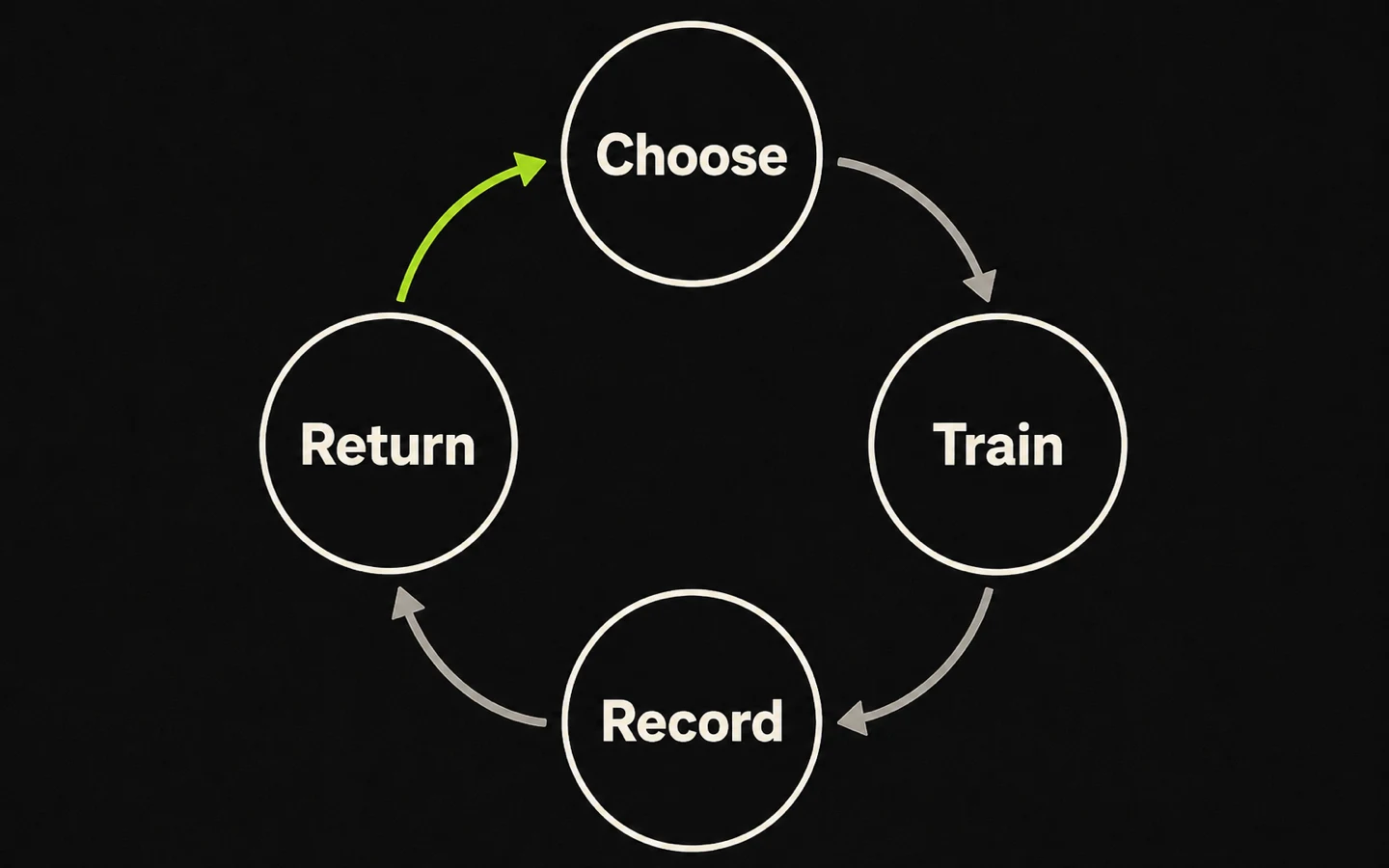
Choose. Train. Record. Return.
The loop is simple, but it changes what a training log is for. A log is not a collection of proof that you worked hard. It is a note to your future self: what you chose, what actually happened and what the next session should account for.
Maybe the weight was comfortable but the setup took too long. Maybe the final repetitions became messy. Maybe the entire session fit into thirty-five minutes and Tuesday evening worked better than you expected. Those observations make the next choice less generic.
This is also the idea behind Ollim. Useful coaching does not begin by pretending it already knows you. It reads what you actually did, then makes the next target more informed. The goal is not to remove you from the decision. It is to give you less guessing to do each time you return.
Your first program will not be perfect. It does not need to be. Its first job is to get out of the notes app, survive contact with a real week and teach you something the next version can use.
Pick the day. Pick the place. Pick the time.
Choose the first day, not the perfect plan.
Sources
- Physical Activity Guidelines for Americans, 2nd edition, U.S. Department of Health and Human Services.
- 5 Things to Know About Creating an Effective Resistance Training Plan, American College of Sports Medicine.