September 18, 2026
Progress should be visible before it feels dramatic
You finish a workout that feels almost identical to the one before it.
The same room. The same movements. The same tired walk home. Nothing about the session feels like a transformation, so it is easy to assume that nothing changed.
Then you look at the record. One more repetition at the same weight. A slightly higher estimate on a familiar lift. Three sessions completed across a week that nearly got away from you. None is a movie-scene breakthrough. Together, they are evidence that was easy to miss while you were doing the work.
TL;DR
Progress does not need to feel dramatic to become visible. Keep a few comparable records, look for small changes across time, and treat each metric as evidence for the next question—not as a final verdict on whether your training is working.
Feeling is a noisy scoreboard
Some sessions feel powerful. Others feel ordinary even when you complete more work. Sleep, stress, equipment, timing, and expectations can all change how a workout feels. That feeling matters, but it is a poor archive on its own.
Memory also compresses the middle. You may remember the first session and the day you set a clear personal best, while the quieter weeks between them blur together. Those weeks are often where the useful pattern lives.
A record gives the ordinary sessions somewhere to go. It does not remove context or tell you what the numbers mean automatically. It simply preserves enough of the work for two moments to be compared after the immediate feeling has passed.
Make the change small enough to see
Start with one familiar exercise. Compare the weight and repetitions you completed across several appearances of that movement. Keep the setup and variation recognizable when circumstances allow.
You might notice that the same load moved for another repetition, that a previous working weight now appears more often, or that you completed the planned work more consistently. You may also see that the numbers have held steady or moved down.
None of those observations needs to be exaggerated. A small increase does not guarantee a long-term outcome, and a flat week does not prove that you have stopped progressing. The value is that the next question becomes more specific. Are the sessions comparable? Was the target completed? Did the plan change? Is there enough history to call this a trend at all?
Visible progress begins by replacing “I think” with something you can inspect.
One number is evidence, not a verdict
Different views of training answer different questions.
Weight and repetitions show what happened in a set. Volume shows how much recorded work accumulated. An estimated one-repetition maximum, or e1RM, uses logged working sets to estimate strength without claiming that you performed a true maximum attempt. A recent PR marks a best recorded estimate or result. Consistency shows whether useful sessions kept arriving.
These numbers can move together, but they do not have to. More volume is not automatically better. One PR does not explain an entire program. An e1RM can change as the underlying sets change and should remain an estimate. A consistency signal says that the plan received input; it does not say that every session was perfect.
The goal is not to find one number that judges the whole month. It is to keep several pieces of evidence in their proper size.
How Ollim makes the record visible
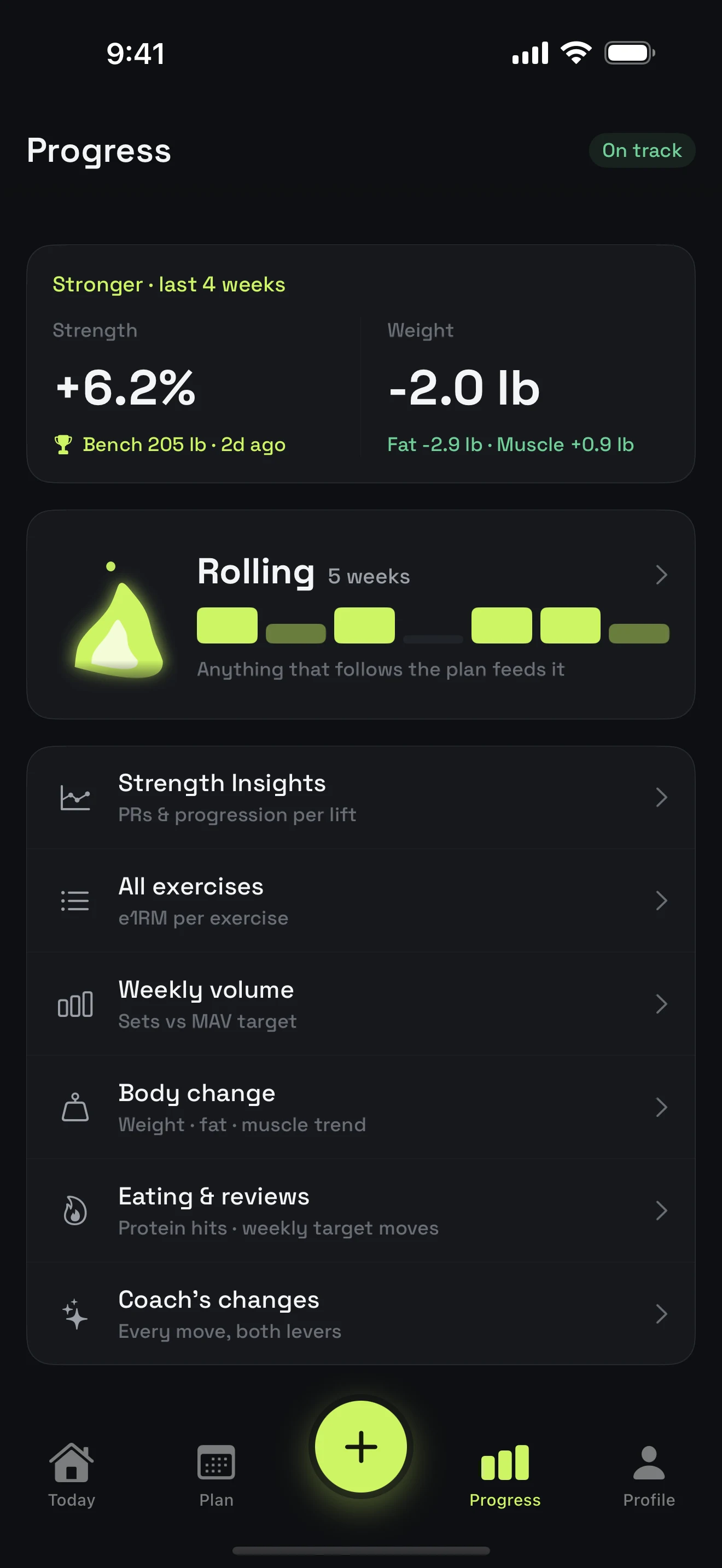
Ollim's Progress screen brings the recent record into one place. It can show a strength trend over the recent window, surface recent PRs, and let you open each exercise to inspect its e1RM history. Weekly volume offers another view of the work you logged. Momentum shows whether the plan kept receiving useful contributions without turning one missed day into a broken streak.
The screen also keeps the coach's changes available, so movement in the record is not separated from movement in the plan. These views do not promise a result or make every fluctuation important. They make the evidence easier to see while it is still small.
That distinction matters. A chart should not manufacture certainty. It should make a better conversation possible: what changed, over what period, and what should the next target consider?
Visibility should lead to a question
When a line moves up, resist the urge to turn it immediately into a prediction. When it stays flat, resist the urge to rebuild everything after one week. First check the record beneath it.
Choose one exercise you have repeated recently. Look at the last three or four times it appeared. Write down one change you can see and one piece of context the numbers do not contain. Maybe the load increased. Maybe the repetitions became steadier. Maybe the equipment changed, or one session was cut short.
You are not searching for a dramatic before-and-after story. You are giving the next decision a clearer starting point.
Notice the change before you demand the transformation.