September 23, 2026
Add weight, hold steady, or take a step back
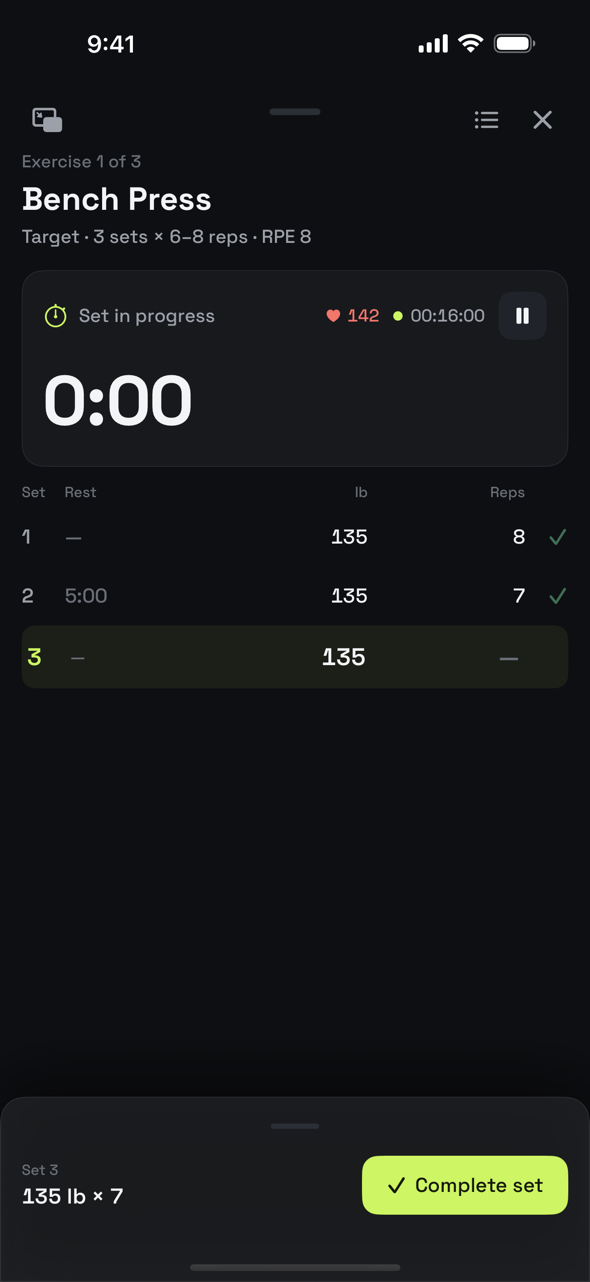
You complete a workout and look for the sign that it counted. The easiest sign to recognize is a bigger number: more weight next time.
But a useful plan cannot answer every session with an increase. Sometimes the completed work earns a step forward. Sometimes the best next target is the same one again. Sometimes the record says the current target needs to become more manageable before you build from it.
Those are not three grades for good, average, and bad effort. They are three different answers to the same question: what does the completed work support next?
TL;DR
Add weight when you completed the prescribed work with evidence that the next step is ready. Hold when the evidence is mixed or another comparable attempt would teach you more. Step back when the same target repeatedly produces a clear problem. All three can be progress.
Add when the target was truly completed
Reaching a repetition number is only useful in context. Did you complete the planned working sets? Did the repetitions reach the top of the target range? Did you use the intended load? If you recorded effort, did the sets stay near the effort target rather than turning into a grind?
When those pieces agree, an increase is no longer a guess based on one exciting set. It is a small response to a completed target.
Small matters here. The purpose of adding weight is not to make the next session impressive. It is to create the next useful challenge while preserving a target you can still understand and record.
Hold when another attempt is more useful
Holding steady is easy to misread as doing nothing. In practice, it protects the comparison.
Maybe the repetitions landed inside the range but not at the top. Maybe one set was unusually hard. Maybe you completed too little of the planned work to know whether the target itself was the problem. An advanced progression may also wait for the same positive signal to appear again instead of moving after one week.
In each case, repeating the target creates information. It asks whether the result was a one-off or part of a pattern. Changing the number immediately would erase that comparison.
A hold is therefore an active decision: keep the question stable long enough to get a clearer answer.
Step back when the same problem repeats
One difficult session can come from many places. Equipment was busy. Sleep was poor. The setup felt unfamiliar. One hard day does not automatically mean the plan needs a smaller number.
Repeated evidence is different. If the same load keeps producing incomplete work or a clear regression, lowering the next target can make the work useful again. In Ollim's beginner linear progression, one missed target repeats the same load; two consecutive misses at that same load can reset it to a lower, practical starting point. Standard programs use their own weekly progression and cadence rules, including a smaller back-off when the required evidence is present.
Stepping back is not a punishment for trying. It reduces the size of the question so you can answer it with better work. The aim is to rebuild, not to prove that the previous attempt was a failure.
Different programs need different clocks
A new lifter benefits from a simple, visible loop between one completed session and the next. Someone with more training history may need repeated weekly evidence before a load moves. A quiet week may call for no change at all, while broader fatigue signals can adjust effort without changing every working weight.
That is why there should not be one universal rule such as “hit the reps, add weight” or “miss once, deload.” The decision has to match the program, the evidence available, and the cadence already in use.
The common principle is smaller: do not ask one data point to make a decision it cannot support.
How Ollim applies the choice
Ollim keeps the original target beside the completed sets: working-set count, repetition range, working weight where available, and optional effort. Its progression paths use that preserved comparison to prepare what comes next.
When you open the next session, you see a concrete target rather than an abstract verdict about whether last week was good or bad. The number may move up, stay where it is, or become more manageable. For eligible standard programs, Weekly Coach can also explain applied changes or bring larger decisions to you instead of silently treating every adjustment as automatic.
You can still change the set in front of you. The prepared target is a starting point, and what you actually complete becomes the next piece of evidence.
Use the three-option check yourself
Choose one exercise you have repeated and look at its last two comparable appearances. Then ask:
- Did I complete the target well enough to add a small step?
- Is the evidence mixed enough that I should repeat it?
- Has the same problem repeated enough that a smaller target would help me rebuild?
Do not force every answer toward “more.” The useful direction is the one the record can explain.
Progress is the next useful decision, not the biggest number.