September 28, 2026
A coach should show its work
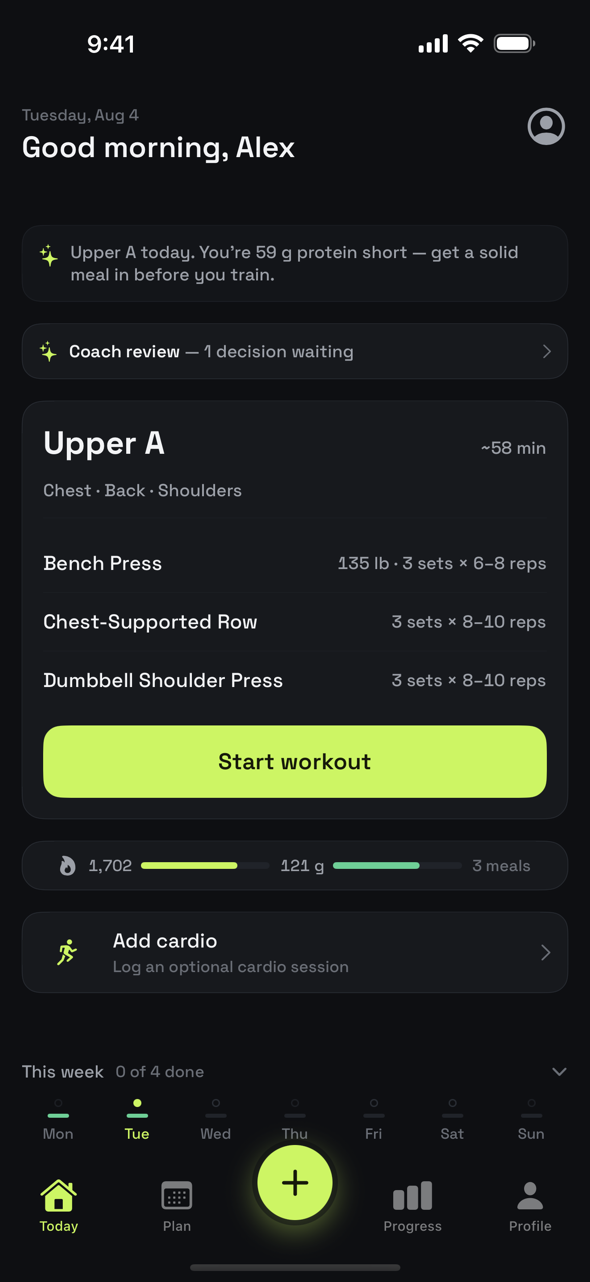
A training plan can look precise and still leave the most important question unanswered.
Why this split? Why this exercise? Why did the target change? Why did nothing change after a week that felt difficult?
“Because the coach decided” is not a useful answer. It asks you to trust authority without giving you anything to inspect. A better answer does not need to reveal every internal calculation. It needs to show the relevant facts, the decision they supported, and the choices that still belong to you.
TL;DR
A coach should make a recommendation inspectable: name the evidence and constraints, show what changed and what stayed the same, and leave the user a clear way to correct the context or reject the result.
Explanation is part of the recommendation
A target without a reason can still be correct. The problem is that you cannot tell whether it is correct for the right reason.
Suppose a program gives you four training days. That could reflect your schedule, the work being distributed, or a limit on session length. Those are different explanations, even if the calendar looks identical.
The explanation helps you evaluate the recommendation when life changes. If you learn that the four-day structure depends on a schedule you no longer have, you know which input needs attention. If it reflects a deliberate trade-off between frequency and shorter sessions, you can decide whether that trade still fits.
An explanation is not decoration beneath the answer. It is what makes the answer usable beyond the moment it appears.
Show evidence, not hidden thought
“Show your work” does not mean publishing a model's private chain of thought. More internal text is not automatically more truthful, and a long explanation can make weak evidence sound impressive.
The useful layer is simpler: verifiable facts and their relationship to the result. Your available days shaped the schedule. Your equipment limited the choices. Your session length created a budget. Your completed training supplied evidence for the next target.
This kind of explanation has boundaries. It should not invent a reason for a slot when the record does not support one. It should distinguish a stored fact from a summary. And it should be willing to say when a request was heard but falls outside what the program can responsibly change.
Clear limits create more trust than confident filler.
Make the consequence visible
Understanding the input is only half of the job. When a recommendation changes the plan, the result should be equally clear.
What moved? What stayed the same? Did the request affect future sessions or rewrite completed training? Was part of the request acknowledged without being applied?
You should not have to search the whole program for side effects. A change receipt turns “I updated your plan” into something checkable. It also keeps the size of the change honest. Asking for more arm work should not imply that every part was rebuilt for a new goal.
Completed history deserves a firm boundary here. A new recommendation can shape what comes next, but it should not rewrite what you already did to make the new answer look consistent.
Leave room to disagree
An understandable recommendation can still be the wrong recommendation for the person using it. The record may be incomplete. Equipment may be unavailable. A schedule may have changed. The user may simply value a different trade-off.
That is why agency belongs in the same loop as explanation. You need a way to add context, ask for a change, and inspect the result. Where reversal is safe, undo should be clear. Where new training has already been logged against the changed plan, the product should say why undo is unavailable.
Trust does not require the coach to be passive. It requires the coach to remain corrigible.
How Ollim applies this principle
Ollim's Why this program view starts with the current plan, not a frozen explanation from the day it was created. It shows the facts that shaped the program, then lets you open each day and see short reasons for the exercises where the product has an honest reason to give.
If something does not fit, you can send one short note to your coach. The response is a receipt, not an endless chat: it separates what changed, what was acknowledged but could not be applied, and what stayed the same. Your logged sessions remain attached to the work you completed.
When the change can safely be reversed, Put it back offers that choice. If later activity makes undo unavailable, Ollim says so. The goal is not to make every recommendation look inevitable. It is to make the recommendation understandable enough for you to keep, question, or correct it.
Four questions for any recommendation
Before accepting the next change to your training, ask:
- What facts shaped this recommendation?
- What constraint or trade-off does it reflect?
- What changed, and what deliberately stayed the same?
- Can I correct the context or reverse the result if it does not fit?
The answer does not need to be long. It needs to be specific enough to inspect.
A coach earns trust by making the next decision understandable—not by asking you to stop questioning it.